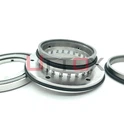
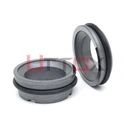
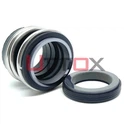
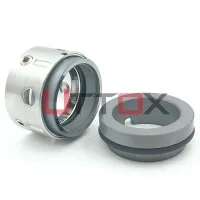
Het gebruik vanmechanische afdichtingenin hogedrukvaten is veel moeilijker dan in midden- en lagedrukvaten, voornamelijk door de hoge druk. Als het onder hoge druk een grote diameter en hoge temperatuur tegenkomt, zal het moeilijker zijn. Bij hoge temperaturen is het materiaal vatbaar voor plastische vervorming en zelfs kruipen, de spanbout zal losraken en het is gemakkelijk te lekken. Bij het ontwerpen van de algehele structuur van het hoge-drukvat moeten we ongetwijfeld eerst overwegen om de diameter van de afdichtingspoort zoveel mogelijk te verkleinen, materialen te selecteren die moeilijk los te maken en te vervormen zijn bij de ontwerptemperatuur en die goede eigenschappen hebben. sterkte en selecteer vervolgens redelijkerwijs een geschikte afdichtingsstructuur om een betrouwbare afdichting te verkrijgen. zegel.
Mechanische afdichtingstechnologie voor hogedrukvaten, van het afdichtingsprincipe en de afdichtingsstructuur, zijn de algemene principes als volgt:
1.Metal gaskets are generally used, and the specific pressure on the high-pressure sealing surface greatly exceeds the sealing specific pressure of medium and low pressure containers, and non-metallic gasket materials cannot achieve such a large sealing specific pressure. Commonly used metal gaskets for high pressure vessels are annealed aluminum, annealed copper or mild steel with good ductility.
2. Er worden smalle gelaatsafdichtingen gebruikt en soms worden zelfs smalle gelaatsafdichtingen geëvolueerd tot lijncontactafdichtingen.
3. Gebruik zo veel mogelijk middelmatige druk om zelf-aanhalende afdichtingen te verkrijgen, omdat zelf-aandraaiende afdichtingen betrouwbaarder en compacter zijn dan geforceerde afdichtingen.
There are many types of high-pressure seals, which are divided into two categories: forced seals and self-tightening seals according to their working principles. Forced sealing relies on the pre-tightening force of the connector (bolt) to ensure a certain contact pressure between the top cover of the pressure vessel, the sealing element and the end of the cylinder to achieve the purpose of sealing. Self-tightening sealing means that as the operating pressure in the pressure vessel increases, the contact pressure between the sealing element, the top cover, and the end of the cylinder also increases, thereby realizing the sealing effect. The characteristics of self-tightening seals are that the higher the pressure, the greater the pressing force of the sealing elements between the contact surfaces, and the better the sealing performance. When the operating conditions fluctuate, the sealing is still reliable, but the structure is more complicated and the manufacturing is more difficult. Self-tightening seals can also be divided into axial self-tightening seals and radial self-tightening seals according to the deformation of the sealing element.
According to the properties of the sealing material, high-pressure seals can be divided into plastic seals that cause plastic deformation of the sealing element and elastic seals that cause elastic deformation of the sealing element.
At present, the commonly used mechanical seals for pressure vessels include flat gasket seals and Kazari seals; semi-self-tightening seals include double cone seals; self-tightening seals include wedge seals, Wood seals, hollow metal O-ring seals, C-ring seals, B Ring seal, triangular pad seal, octagonal pad seal, flat pad self-tightening seal and rubber O-ring seal, etc.
In the appendix of the national standard for steel pressure vessels in my country, several commonly used mechanical seals structures are recommended based on experience and structural characteristics, which can be reasonably selected in combination with operating conditions during design.